
We Examine. You Judge.
Shuffleboard: Yes, People Still Give a Puck*
THE BAR EXAMINER PRESENTS
Bar Lore & History
Tales from behind the taps.
*Editor’s note: Four pucks per player or team. Eight total. We apologize for the ambiguity.
Shuffleboard: Wood, Wax & Pucks — Not Dead Yet!
Somewhere in America, tucked into the corner of a neighborhood dive bar, there’s a shuffleboard table that might be older than half the customers.
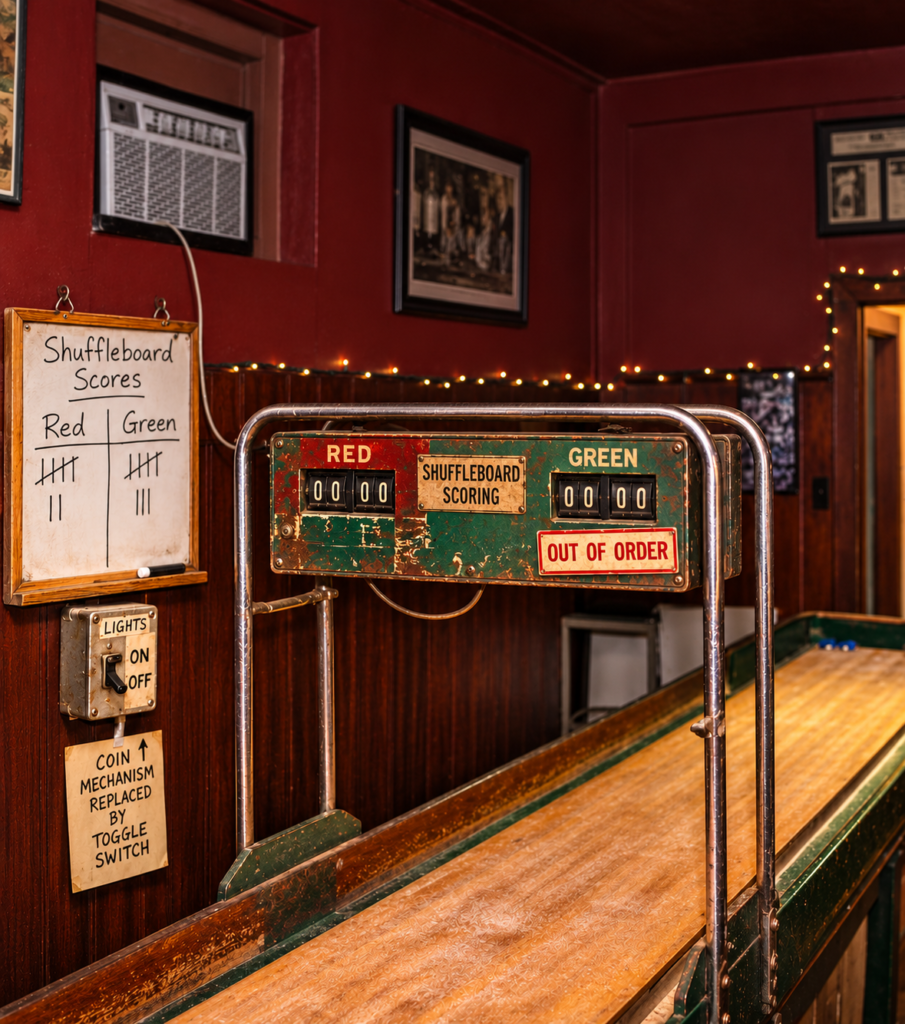
The electronic scoreboard hasn’t worked in decades. The lights operate from a toggle switch that looks suspiciously homemade. And the bartender has exactly one rule: you can play all night, provided you keep buying drinks.
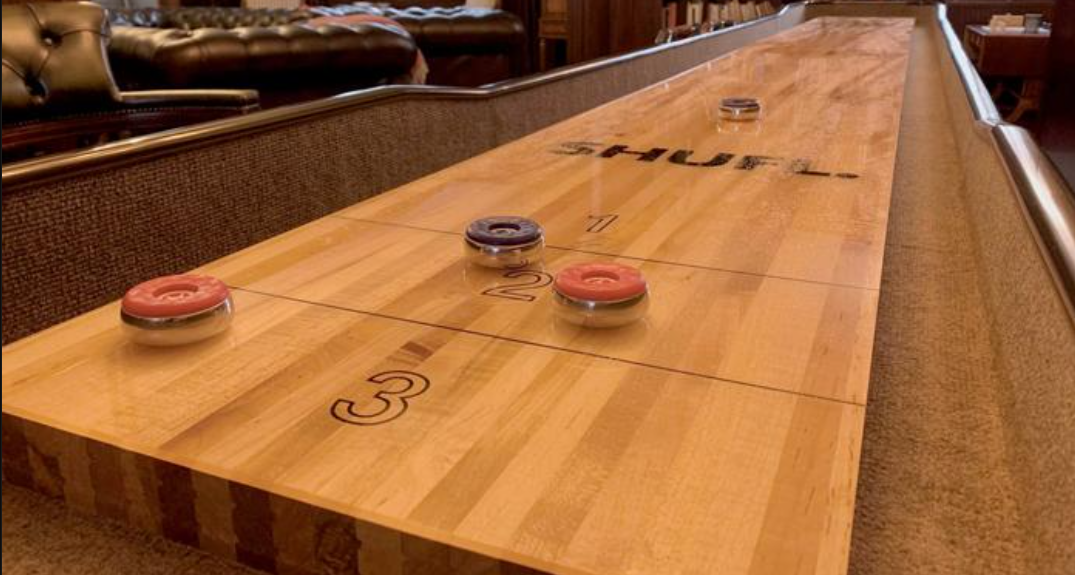
No quarters. No reservations. Just a long wooden table, a handful of metal pucks, and the occasional argument over whether that last shot was worth three points.
For some people, that’s reason enough to visit a bar.
From English Taverns to American Bars
Shuffleboard has been around considerably longer than the United States.
Its roots stretch back to 15th-century England, where players slid coins called groats along tables. Early versions went by names like shove-groat and slide-groat.
Over the centuries, the game evolved into the long-table version that became part of American tavern culture.
By the 1940s and 1950s, table shuffleboard was enjoying a golden age. Bars hosted competitions, manufacturers sponsored tournaments, and serious players developed reputations for their skill.
Its popularity later declined, but dedicated players kept the tradition alive. Organizations like the Shuffleboard Federation continue to support competitive play and preserve the game’s history.
And here’s something worth remembering: shuffleboard was an indoor table game long before it became associated with Florida retirement communities.
Two Shuffleboards. Two Very Different Games.
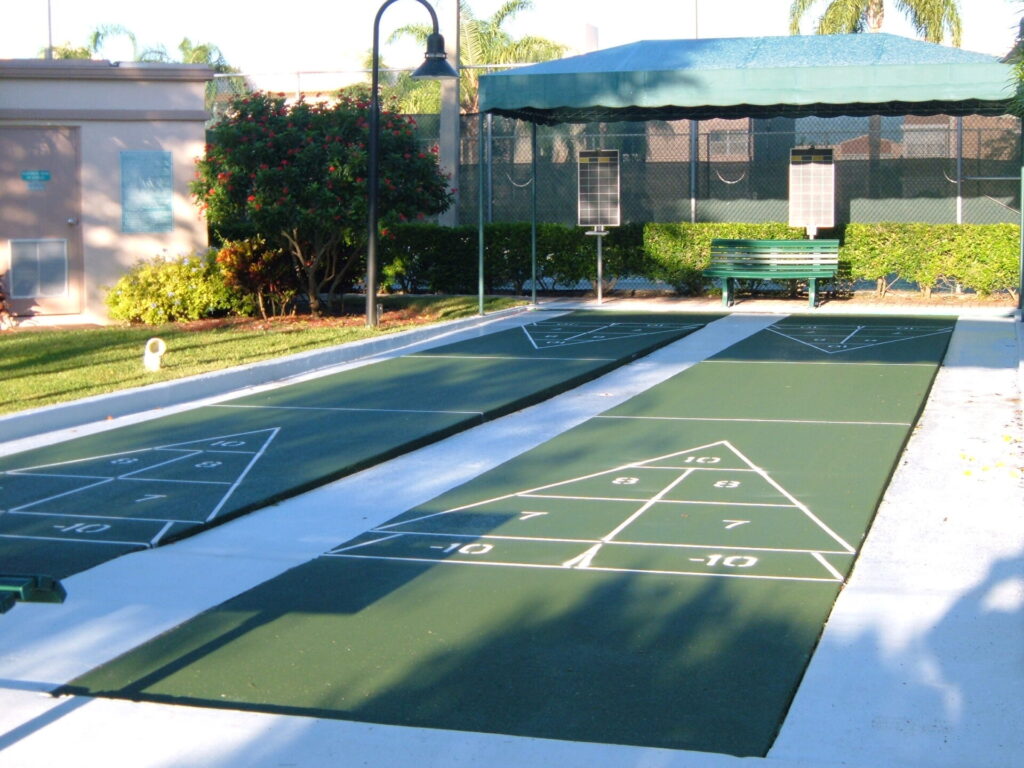
Mention shuffleboard and some people picture retirees in Florida pushing discs across a painted concrete court.
Others picture a dimly lit tavern, a 22-foot wooden table, and somebody yelling because their perfect shot just got knocked into the gutter.
Both games are called shuffleboard, but they’re distinctly different.
Outdoor shuffleboard, also called court or deck shuffleboard, uses long cues to push discs along a marked playing surface. It’s familiar from cruise ships, resorts, and retirement communities.
Table shuffleboard uses weighted pucks pushed by hand along a narrow wooden playing surface. Tables come in several lengths, with full-sized models commonly measuring 22 feet.
Players try to land their pucks in scoring zones while knocking opponents out of position.
Of course, we’re not suggesting a bar couldn’t offer outdoor shuffleboard indoors.
We just haven’t found one yet.
Then again, we haven’t found a bar offering alligator wrestling either.
But rumors persist.
And for God’s Sake, It’s Not Sand
Let’s clear up one of the great misunderstandings of barroom recreation.
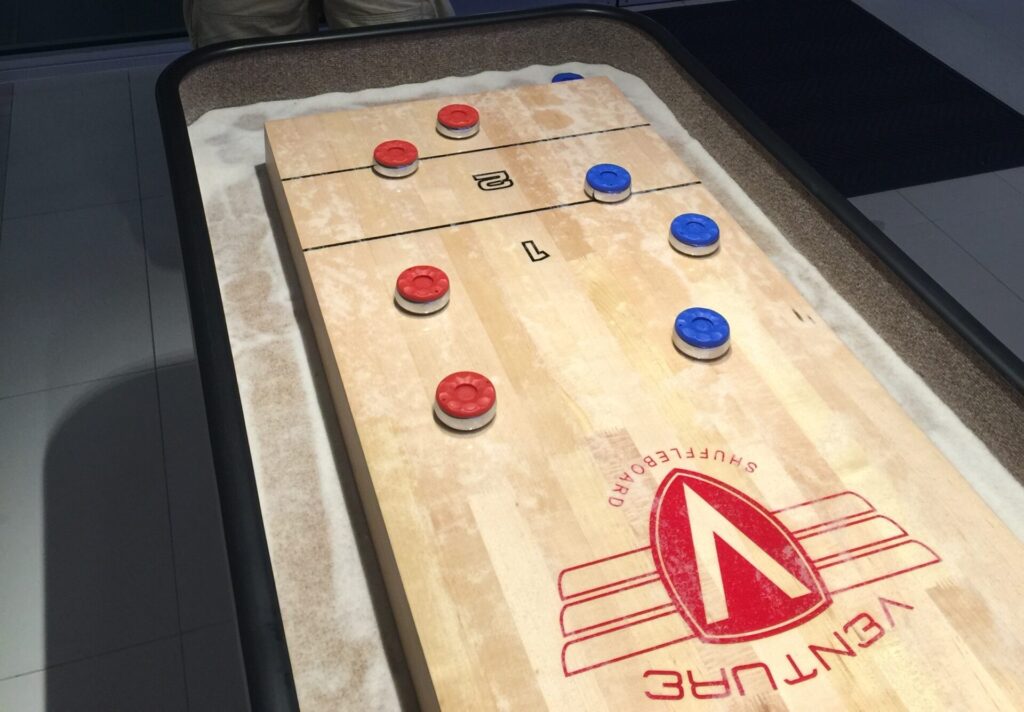
That powder sprinkled across the table?
People call it sand.
It’s not ordinary sand.
It’s commonly known as shuffleboard wax, speed powder, or shuffleboard powder.
Despite the name, modern shuffleboard wax isn’t necessarily made from wax. Many formulations use tiny silicone beads, sometimes mixed with cornstarch or other ingredients.
The powder reduces friction, allowing the pucks to glide smoothly across the playing surface.
Different formulations produce different playing speeds, and proper maintenance helps keep the game consistent.
So the next time somebody asks you to throw more sand on the table, you can explain the science.
Or you can keep drinking your beer.
Your call.
And really, table shuffleboard is a little like curling. Except without the ice, stones, or brooms.
Unless you count that one “pro” who insists on wiping off all the perfectly good shuffleboard wax (sand) and applying a fresh layer before every game.
There’s always one.
When Shuffleboard Was Just Part of the Bar
There was a certain charm to the old neighborhood-bar shuffleboard table.
Some looked like they’d been installed when Eisenhower was president.
The electronic scoring system might have stopped working decades earlier. The lights might operate from a toggle switch somebody wired in as an afterthought.
Nobody particularly cared.
You kept score yourself. You played until somebody else wanted a turn. And in some bars, playing was free as long as you kept buying drinks.
It was an arrangement that made perfect sense.
The bar wasn’t necessarily trying to make money directly from the shuffleboard table.
The shuffleboard table was helping the bar make money.
Of course, not every establishment embraced that philosophy.
Which brings us to one of the more intimidating inventions in barroom economics.
Enter the Death Spikes
Some coin-operated shuffleboard tables feature a mechanical device known as a pingate.
Its purpose isn’t to make the game harder.
It’s to prevent you from playing without paying.
Depending on the equipment, a mechanical barrier blocks the playing surface until the payment system activates the table.
Essentially, somebody looked at a perfectly enjoyable game and decided it needed retractable anti-freeloading hardware.
We’ll call them death spikes.
To be fair, bar owners have every right to charge for entertainment, and coin-operated shuffleboards aren’t a new invention.
But there’s something wonderfully absurd about a game that requires mechanical intervention to stop people from enjoying it for free.
Somewhere, an old bartender with a broken scoreboard and a toggle switch is probably shaking his head.
Not Dead. Just Harder to Find.
Shuffleboard hasn’t disappeared.
Competitive tournaments still exist. Dedicated players continue to compete. And modern entertainment venues have introduced table shuffleboard to audiences who may never have encountered it in an old neighborhood tavern.
But there’s still something special about discovering one of those traditional tables in an otherwise unremarkable little bar.
The beer might be ordinary. The decor might not have changed since 1978. The regulars might look at you suspiciously when you walk in.
But there’s a beautiful wooden shuffleboard table in the back.
And suddenly, that place has something the shiny new sports bar down the street doesn’t.
And suddenly, that place has something the shiny new sports bar down the street doesn’t.
The tables may be harder to find. The scoreboards may have stopped working decades ago. But after all these years, people are still pucking.
Sometimes a bar doesn’t need to be the best bar in town.
It just needs one damn good reason to visit.
Find Shuffleboard Near You
Love a good game of shuffleboard? Let’s see who’s got a table near you.
This search uses The Bar Examiner’s local bar directory. You’ll confirm your search location before viewing results. Availability varies by area, and not every bar or amenity may be listed yet.
Know a Table We’re Missing?
We’re looking for Toledo-area bars that still have traditional table shuffleboard.
Know a place with one? Let us know.
And if you own or manage a bar with a shuffleboard table, make sure it’s included among your amenities on The Bar Examiner.
Because somewhere out there, somebody is looking for exactly what your bar has to offer.
Know Something We Don’t?
Know a bar we’re missing? Have information we should add or correct? Help us keep The Bar Examiner accurate and up to date.